
How to Calculate rectangular water tank size and capacity
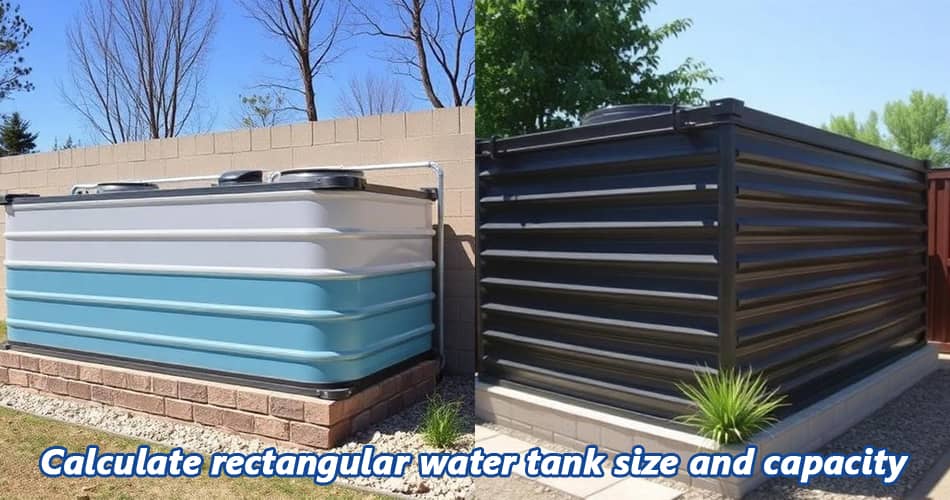
How to Calculate Rectangular Water Tank Size and Capacity
Calculating the correct rectangular water tank size and capacity is essential for residential buildings, commercial properties, industrial facilities, agricultural applications, and infrastructure projects. A properly sized tank ensures that sufficient water is available when required without unnecessarily increasing construction costs, structural loads, space requirements, or maintenance expenses.
For a rectangular water tank, the basic calculation is straightforward because its volume is determined from three dimensions: length, width, and water depth. Once these dimensions are known, we can calculate the volume and convert it into litres, cubic metres, gallons, or other required units.
This guide explains how to calculate rectangular water tank capacity, how to determine the required tank dimensions, how to account for freeboard and usable capacity, and how to avoid common calculation mistakes.
Rectangular Water Tank Capacity Formula
The basic formula for calculating the volume of a rectangular water tank is:
Volume = Length x Width x Height
Where:
- Length = internal length of the tank
- Width = internal width of the tank
- Height = internal water depth
- Volume = capacity of the tank in cubic metres when dimensions are measured in metres
For example, if a tank has:
- Length = 4 m
- Width = 3 m
- Water depth = 2 m
Then:
Volume = 4 x 3 x 2
Volume = 24 m3
Since one cubic metre of water is equal to 1,000 litres:
Tank capacity = 24 x 1,000 = 24,000 litres
Therefore, the tank can hold approximately 24,000 litres of water at the stated water depth.
How to Calculate Water Tank Capacity in Litres
For many building and plumbing applications, tank capacity is expressed in litres rather than cubic metres.
If the dimensions are given in metres, use:
Capacity in litres = Length x Width x Water Depth x 1,000
Example: 5 m x 4 m x 2 m Tank
Suppose we have a rectangular water tank with:
- Length = 5 m
- Width = 4 m
- Water depth = 2 m
The calculation is:
Capacity = 5 x 4 x 2 x 1,000
Capacity = 40,000 litres
Thus, the rectangular tank has a capacity of 40,000 litres.
How to Calculate a 10,000-Litre Rectangular Water Tank
When the required tank capacity is already known, we can work backward to determine suitable dimensions.
A 10,000-litre tank contains:
10,000 litres ÷ 1,000 = 10 m3
Therefore, we need a tank with an internal volume of 10 cubic metres.
One possible combination is:
- Length = 2.5 m
- Width = 2 m
- Water depth = 2 m
Calculation:
2.5 x 2 x 2 = 10 m3
Therefore:
10 m3 x 1,000 = 10,000 litres
The internal tank dimensions would provide a theoretical capacity of 10,000 litres when filled to the calculated water depth.
How to Calculate a 20,000-Litre Rectangular Water Tank
A 20,000-litre tank requires:
20,000 ÷ 1,000 = 20 m3
We can select dimensions whose product equals 20 m3.
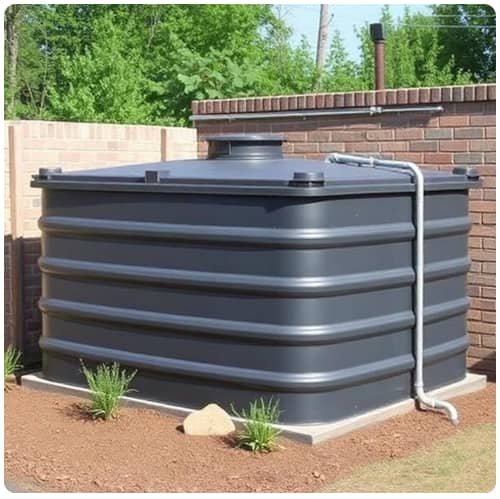
For example:
- Length = 4 m
- Width = 2.5 m
- Water depth = 2 m
Therefore:
4 x 2.5 x 2 = 20 m3
And:
20 x 1,000 = 20,000 litres
Hence, the tank provides a theoretical storage capacity of 20,000 litres.
How to Calculate a 50,000-Litre Rectangular Water Tank
For a 50,000-litre water tank:
50,000 ÷ 1,000 = 50 m3
One possible tank configuration is:
- Length = 5 m
- Width = 5 m
- Water depth = 2 m
Therefore:
5 x 5 x 2 = 50 m3
The capacity is:
50 x 1,000 = 50,000 litres
This demonstrates an important principle: different combinations of length, width, and depth can provide the same storage capacity.
How to Determine Rectangular Water Tank Dimensions
When designing a tank, we usually start with the required storage capacity and then determine dimensions based on available space, structural requirements, accessibility, construction methods, and operating conditions.
The general relationship is:
Required Volume = Length x Width x Water Depth
If two dimensions are already known, the third dimension can be calculated.
For example, suppose we need a tank with a capacity of 30,000 litres, and the proposed dimensions are:
- Length = 5 m
- Width = 3 m
- Required water depth = ?
First, convert the capacity:
30,000 litres = 30 m3
Now:
30 = 5 x 3 x Depth
Therefore:
Depth = 30 ÷ 15
Depth = 2 m
The required internal water depth is therefore 2 metres.
Rectangular Water Tank Capacity Calculation Table
| Length | Width | Water Depth | Capacity |
|---|---|---|---|
| 2 m | 2 m | 2 m | 8,000 litres |
| 3 m | 2 m | 2 m | 12,000 litres |
| 4 m | 3 m | 2 m | 24,000 litres |
| 5 m | 3 m | 2 m | 30,000 litres |
| 5 m | 4 m | 2 m | 40,000 litres |
| 5 m | 5 m | 2 m | 50,000 litres |
| 6 m | 4 m | 2 m | 48,000 litres |
| 6 m | 5 m | 2 m | 60,000 litres |
These values represent theoretical internal capacities based on the stated dimensions.
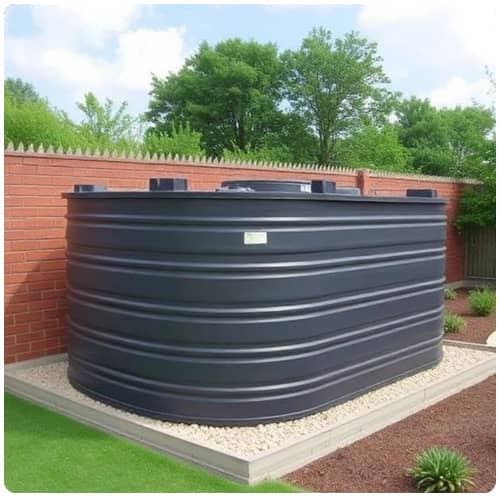
Internal Dimensions vs. External Dimensions
One of the most important considerations when calculating a water tank capacity is whether the dimensions are internal or external.
The volume formula should normally use the internal dimensions of the tank, because water occupies the internal space.
For example, if a concrete tank has external dimensions of 5 m x 4 m and its walls are 200 mm thick, the internal dimensions will be smaller.
If the wall thickness is 200 mm on each side:
Internal Length = 5 - 0.2 - 0.2 = 4.6 m
Internal Width = 4 - 0.2 - 0.2 = 3.6 m
The capacity should then be calculated using these internal dimensions rather than the external dimensions.
This distinction becomes particularly important for reinforced concrete water tanks, where wall, base, roof, waterproofing, and finishing thicknesses can significantly affect the available internal volume.
Freeboard in Rectangular Water Tanks
A water tank is not always filled completely to the top. A certain vertical space may be provided above the normal operating water level. This space is commonly referred to as freeboard.
For example, consider a tank with:
- Internal length = 4 m
- Internal width = 3 m
- Total internal height = 2.5 m
- Freeboard = 0.3 m
The effective water depth is:
2.5 - 0.3 = 2.2 m
Therefore:
Water volume = 4 x 3 x 2.2
Water volume = 26.4 m3
Thus, the usable water capacity at the specified operating level is:
26.4 x 1,000 = 26,400 litres
The total geometric volume is larger, but the usable operating capacity is based on the actual water level.
Gross Capacity and Usable Capacity
We should distinguish between gross tank capacity and usable water capacity.
Gross capacity is the total geometric volume enclosed by the tank.
Usable capacity is the amount of water that can practically be stored and withdrawn during normal operation.
Usable capacity may be lower because of:
- Freeboard
- Minimum operating water level
- Outlet position
- Sediment accumulation
- Pump suction requirements
- Internal fittings
- Safety requirements
For example, a tank may have a gross capacity of 30,000 litres but a practical usable capacity of 25,000 or 27,000 litres depending on its operating arrangement.
How to Calculate Water Tank Capacity in Cubic Feet
In some construction projects, dimensions are measured in feet.
The formula remains:
Volume = Length x Width x Depth
If all dimensions are in feet, the result is in cubic feet (ft3).
For example:
- Length = 12 ft
- Width = 8 ft
- Depth = 6 ft
Then:
Volume = 12 x 8 x 6
Volume = 576 ft3
To convert cubic feet into litres:
1 cubic foot ≈ 28.3168 litres
Therefore:
576 x 28.3168 ≈ 16,310 litres
So the theoretical capacity is approximately 16,310 litres.
How to Convert Cubic Metres to Litres
The conversion between cubic metres and litres is simple:
1 m3 = 1,000 litres
Therefore:
- 1 m3 = 1,000 litres
- 5 m3 = 5,000 litres
- 10 m3 = 10,000 litres
- 20 m3 = 20,000 litres
- 30 m3 = 30,000 litres
- 50 m3 = 50,000 litres
- 100 m3 = 100,000 litres
This conversion makes it easy to move between engineering calculations and practical water-storage capacities.
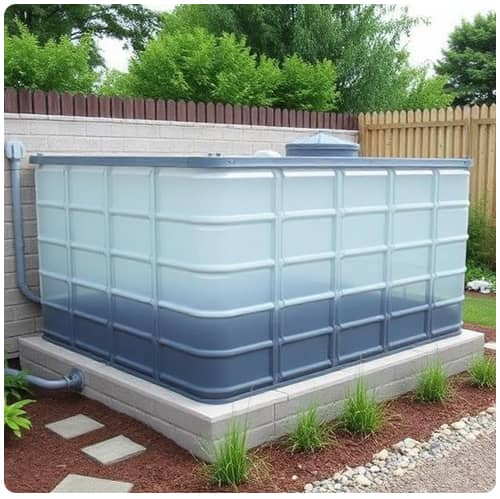
How to Calculate Tank Size Based on Daily Water Demand
Tank sizing should not always begin with arbitrary dimensions. For many applications, we first determine the required water storage based on daily demand.
A simplified calculation is:
Required Storage = Daily Water Demand x Number of Storage Days
For example, if a building requires approximately 8,000 litres of water per day and we want two days of storage:
Required Storage = 8,000 x 2
Required Storage = 16,000 litres
We can therefore consider a tank with a usable capacity of approximately 16,000 litres, subject to the project's actual water-demand assessment and design requirements.
For buildings with variable demand, additional factors may need to be considered, such as peak consumption, supply reliability, fire-water requirements, emergency storage, and local regulations.
Rectangular Water Tank Size Calculator Formula
A simple calculation method can be summarized as follows:
If dimensions are known
Capacity in litres = L x W x H x 1,000
where L, W, and H are measured in metres.
If capacity is known
First convert litres to cubic metres:
Required Volume = Capacity in Litres ÷ 1,000
Then:
Required Depth = Required Volume ÷ (Length x Width)
Similarly:
Required Length = Required Volume ÷ (Width x Depth)
And:
Required Width = Required Volume ÷ (Length x Depth)
These formulas allow us to determine any missing tank dimension when the other dimensions and required capacity are known.
Example of Complete Rectangular Tank Size Calculation
Let us consider a proposed underground rectangular water tank with:
- Internal length = 6 m
- Internal width = 4 m
- Total internal height = 2.5 m
- Freeboard = 0.25 m
Step 1: Calculate Effective Water Depth
Water Depth = 2.5 - 0.25
Water Depth = 2.25 m
Step 2: Calculate Usable Volume
Volume = 6 x 4 x 2.25
Volume = 54 m3
Step 3: Convert Volume into Litres
Capacity = 54 x 1,000
Capacity = 54,000 litres
Therefore, the tank has a theoretical usable water capacity of approximately 54,000 litres at the specified operating water level.
Common Mistakes in Rectangular Water Tank Capacity Calculations
Several mistakes can lead to incorrect tank capacities.
Using External Dimensions
Using external dimensions instead of internal dimensions can overestimate the amount of water that the tank can hold.
Ignoring Freeboard
If the tank is designed with freeboard, the entire internal height should not automatically be treated as the operating water depth.
Mixing Measurement Units
Length, width, and depth must use consistent units. We should not multiply metres by feet or millimetres without first converting the measurements.
Forgetting the 1,000 Conversion
When dimensions are in metres, the volume is obtained in cubic metres. To convert it into litres, multiply by 1,000.
Confusing Gross and Usable Capacity
The geometric volume does not necessarily represent the actual quantity of water available for normal use.
Ignoring Tank Geometry
The rectangular formula applies to tanks with a rectangular internal geometry. Tanks with sloped bases, curved walls, chamfered corners, internal compartments, or irregular shapes may require separate calculations.
Factors to Consider When Designing a Rectangular Water Tank
Capacity is only one part of water tank design. We should also consider:
- Available site area
- Required storage capacity
- Water demand
- Tank depth
- Freeboard
- Structural loading
- Concrete and reinforcement requirements
- Waterproofing
- Inlet and outlet arrangements
- Overflow and drain systems
- Access openings
- Cleaning requirements
- Ventilation
- Pump and pipe connections
- Maintenance access
- Groundwater conditions for underground tanks
- Applicable building and water-storage standards
For reinforced concrete tanks, structural design should be carried out by a qualified engineer because the tank must resist hydrostatic pressure, soil pressure where applicable, uplift, cracking, temperature effects, and other relevant loads.
Rectangular Water Tank Capacity: Quick Reference
The most useful formula to remember is:
Capacity in litres = Length x Width x Water Depth x 1,000
For example:
4 m x 3 m x 2 m x 1,000 = 24,000 litres
Therefore, a rectangular tank measuring 4 m long x 3 m wide x 2 m effective water depth can store approximately 24,000 litres of water.
If the dimensions are provided in millimetres, convert them to metres before using the formula. For example:
4,000 mm = 4 m
3,000 mm = 3 m
2,000 mm = 2 m
Then apply the standard volume equation.
Conclusion
Calculating the size and capacity of a rectangular water tank is fundamentally a matter of determining its internal volume. By multiplying the internal length, width, and effective water depth, we can calculate the volume in cubic metres and then convert that value into litres.
The core formula is:
Rectangular Tank Volume = Length x Width x Water Depth
and:
Rectangular Tank Capacity = Length x Width x Water Depth x 1,000 litres
For accurate real-world design, we should distinguish between gross capacity and usable capacity, account for freeboard, use internal dimensions, maintain consistent units, and consider the tank's structural and operational requirements.
A correctly calculated rectangular water tank provides the required storage capacity while making efficient use of available space and construction resources. For larger reinforced concrete or underground tanks, the volume calculation should form part of a broader engineering design that addresses structural safety, waterproofing, drainage, access, maintenance, and applicable standards.