
How to Find Volume of a Slump Cone | Slump Test of Concrete
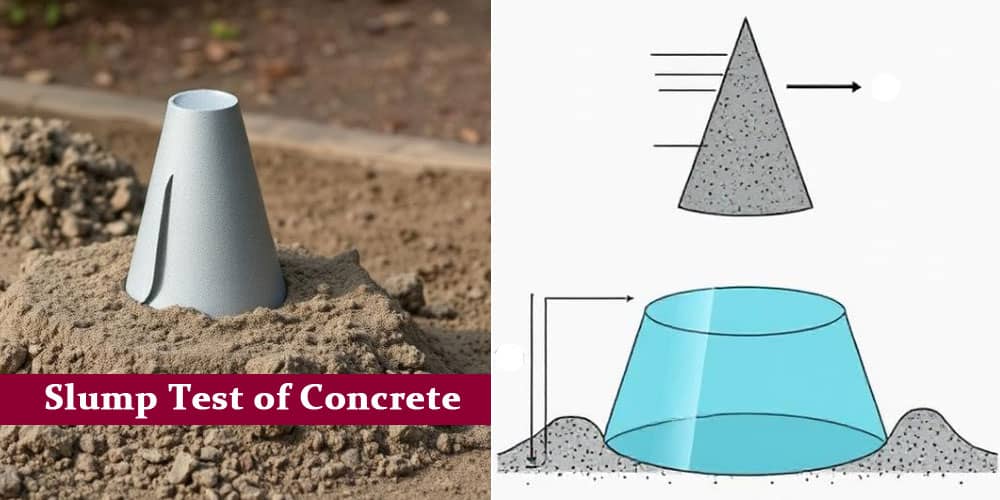
The slump test is a crucial procedure used in the construction industry to measure the workability or consistency of fresh concrete. The primary objective of the slump test is to determine the ease with which concrete flows. One key aspect of this test is the calculation of the volume of the slump cone used in the test.
What is a Slump Cone?
A slump cone is a standard tool used to conduct the slump test. It has a frustum shape, meaning it is a cone with a circular base and a truncated top. The cone is made of steel or plastic and is used to evaluate the flowability of fresh concrete by observing how much it slumps or deforms under its own weight.
Dimensions of a Standard Slump Cone
The standard slump cone typically has the following dimensions:
- Bottom Diameter: 200 mm (8 inches)
- Top Diameter: 100 mm (4 inches)
- Height: 300 mm (12 inches)
These dimensions are standardized as per the ASTM C143 or IS 1199.
Formula to Calculate the Volume of a Slump Cone
The volume of a truncated cone (frustum) can be calculated using the following formula:
Where:
V = Volume of the cone
h = Height of the cone
R1 = Radius of the bottom base
R2= Radius of the top base
Π = 3.14159
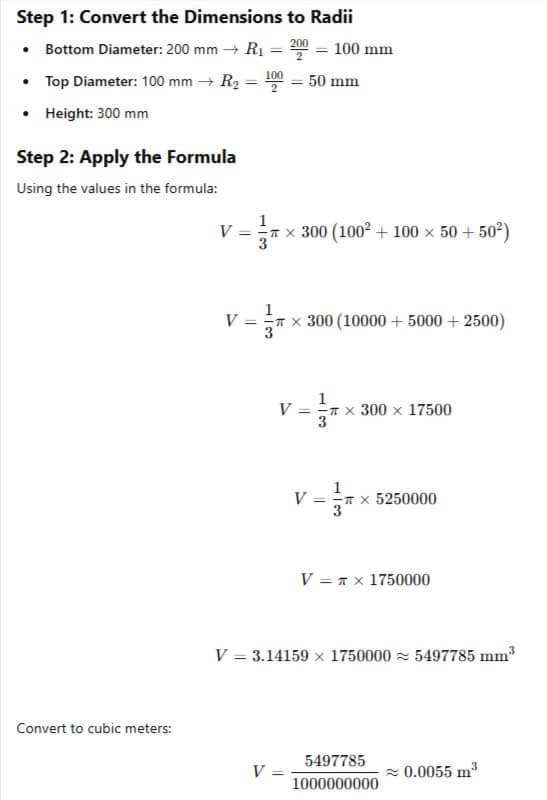
Step-by-Step Calculation of Slump Cone Volume
Final Volume of the Slump Cone
The volume of the slump cone is approximately 0.0055 cubic meters or 5.5 liters.
Purpose and Importance of Slump Test
The slump test is essential for checking the workability of concrete before it is placed in construction. Here are a few reasons why the slump test is widely used:
- Workability Assessment: Ensures the concrete has the right consistency for easy placement and compaction.
- Quality Control: Identifies any irregularities in the concrete mix that may affect structural integrity.
- Compliance Check: Confirms that the concrete conforms to design specifications and standards.
- Preventing Defects: Minimizes issues like segregation, bleeding, or poor finish due to incorrect slump values.
Interpreting Slump Test Results
The measured slump value from the test helps assess the concrete's behavior. Based on the slump, concrete can be classified into different categories:
- True Slump: Concrete maintains its shape with only slight settlement.
- Shear Slump: Concrete slides down in a sheared form, indicating poor cohesion.
- Collapse Slump: Concrete collapses completely, suggesting excessive water content.
Recommended Slump Values for Different Applications
| Application | Slump Range (mm) |
|---|---|
| Reinforced Foundations | 75 - 100 |
| Pavements & Mass Concrete | 25 - 50 |
| Beams & Slabs | 50 - 100 |
| Columns | 75 - 150 |
Conclusion
Calculating the volume of a slump cone is essential for understanding the concrete's characteristics during the slump test. By accurately measuring the volume, we can ensure correct slump values that reflect the concrete's workability. This simple yet effective test remains an indispensable tool in construction quality control.